- Film
Past Disquiet: Screenings
A discursive programme by Kristine Khouri and Rasha Salti
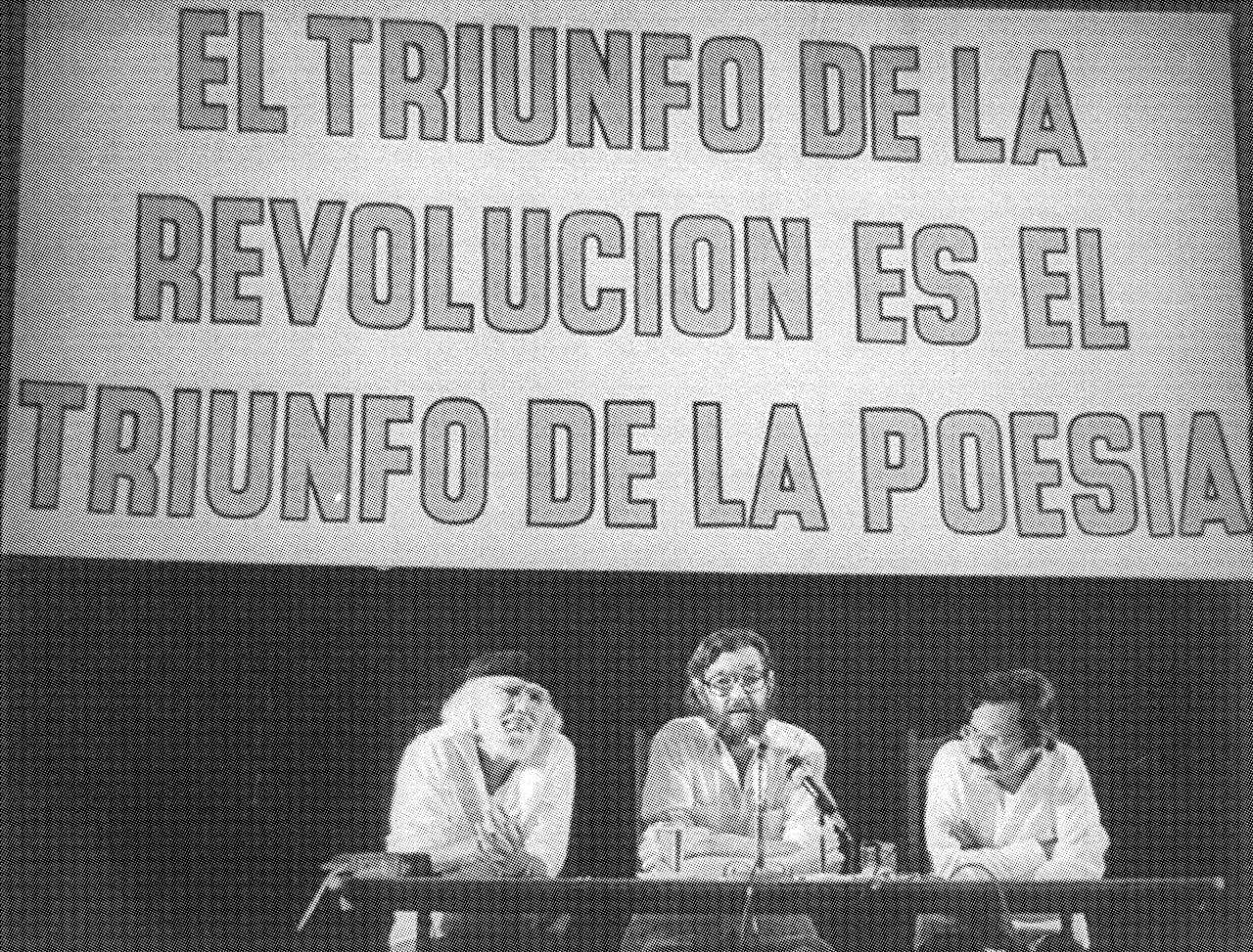
"The triumph of the revolution is the triumph of poetry", Seated L-R: Ernesto Cardenal, Julio Cortázar, Julio Valle-Castillo, c. 1980-1983, Managua. Courtesy: Juilio Valle-Castilo, Matías Salvador Villa Juica.
- Date and Time:
Saturday 31 Jan - Sunday 8 Feb 2026,
All day during opening hours- Location:
- Minassa
The screening programme runs during opening hours from 31 January-8 February and is screened twice daily from 11am-2:30pm and 2:30-6:00pm. All screenings are free with no registration required.
A museum in solidarity is a collection of artworks donated by artists, their gift being a political gesture intended to demonstrate support for a movement of national liberation or a struggle for justice and equality. Museum-in-exile is often the form they take—living outside of the country or cause they are supporting, in exile and touring until they can return or go ‘home.’ Solidarity collections are important models of museology that have been almost entirely marginalised in the annals of art history and museum studies. Kristine Khouri and Rasha Salti, co-curators of Past Disquiet, have assembled videos to tell the story of each museum.
Screening Programme 1: Museo de la Solidaridad, Museo Internacional de la Resistencia Salvador Allende and the Museo de Arte Latinoamericano en Solidaridad con Nicaragua
Showing at 11am-12pm and 2:30-3:30pm; Duration 50:34 min
The novel proposal of creating a solidarity museum took shape a few months after Salvador Allende’s leftist Popular Unity government took office in 1971. The project of the Museo de la Solidaridad (Museum of Solidarity) drew over 650 artworks by artists from around the world and was inaugurated in 1972. After the coup d’état on September 11, 1973, several prominent Chilean exiles with members of the International Committee of Artistic Solidarity with Chile envisioned The Museo Internacional de la Resistencia Salvador Allende (MIRSA) which. Conceived as a museum-in-exile and it was presented as a continuously growing collection and itinerant exhibition that would find haven in different places until it could return home to Chile after justice and democracy were restored and liberation achieved.
In 1980, during a festival in Rome held to celebrate the first anniversary of the Sandinista revolution in Nicaragua, Ernesto Cardenal, then Minister of Culture in the new Nicaraguan government, met Carmen Waugh, a Chilean arts administrator who had played a key role in establishing the MIRSA. The idea for a museum in solidarity with the Nicaraguan people was born. The collection (of nearly three hundred works) was sent to Managua and was inaugurated in December 1982 as the Museo de Arte Latinoamericano en Solidaridad con Nicaragua after which time it continued to grow.
Screening Programme 2: Art Contre/Against Apartheid
Showing at 12-1pm and 3:30-4:30pm; Duration 48:24 min
On November 6, 1962, the UN General Assembly established the United Nations Special Committee against Apartheid. The committee reached out to French artist Ernest Pignon-Ernest to mobilise international artists to endorse the campaign against apartheid. Inspired by the MIRSA, Ernest Pignon-Ernest and Spanish artist Antonio Saura, proposed to establish a museum-in-exile in the form of an itinerant exhibition of artworks incarnating international artists’ rejection of the apartheid regime in South Africa. They established the Artists of the World Against Apartheid Committee to oversee the collection of artworks and tour of the exhibition. The collection consisted of approximately one hundred works by ninety-six internationally acclaimed artists and writers were assembled. After opening in Paris in 1983, the Art Contre/Against Apartheid exhibition travelled to forty countries.
After the collapse of the apartheid regime, the collection was donated to the government of South Africa and was exhibited in the Houses of Parliament in Cape Town for the nation’s first democratically elected legislators.
Screening Programme 3: International Art Exhibition for Palestine
Showing at 1-1:30pm and 4:30-5pm; Duration 29:07 min
The fourth and last museum-in-exile, or solidarity, is the story of the International Art Exhibition for Palestine. Organised by the Palestine Liberation Organisation (PLO) through the Plastic Arts Section of its Office of Unified Information, the exhibition was inaugurated in the basement hall of the Beirut Arab University on March 21, 1978. In 1982, the Israeli military advanced into Beirut again, holding the city under siege with the objective of forcing the PLO to quit Lebanon. The building where the collection of artworks had been stored was shelled. All that remains of the story of the International Art Exhibition for Palestine are the memories of those who made it happen and who visited it.
Screening Programme 4: The PLO Representatives and the Arts
Showing at 1:30-2:30pm and 5-6pm; Duration 50:41 min
The PLO was only recognised as the official and legitimate representative body of Palestinians at the UN General Assembly in 1974. With the help of the Arab League, the organisation lobbied to establish offices to represent Palestine that functioned like makeshift embassies. The first generation of representatives was culled from refugee camps and the diaspora; their political imaginaries and aspirations were informed by the lived experience of indignity and the revolutionary emancipatory fervour that swept the region and the world. Some representatives, like, Fathi Abdul-Hamid (posted in Tokyo), Mahmoud al-Hamshari (Paris), Ezzeddine Kalak (Paris), Naïm Khader (Brussels), Wajih Qasem (Rabat), and Wael Zuwaiter (Rome), believed that mobilising support for the Palestinian cause had to involve thorough, patient, and creative engagement with unions, syndicates, and collectives of students, workers, and artists. In the countries where they were posted, they inspired artists and intellectuals to see in Palestine a mirror of the world’s injustice.